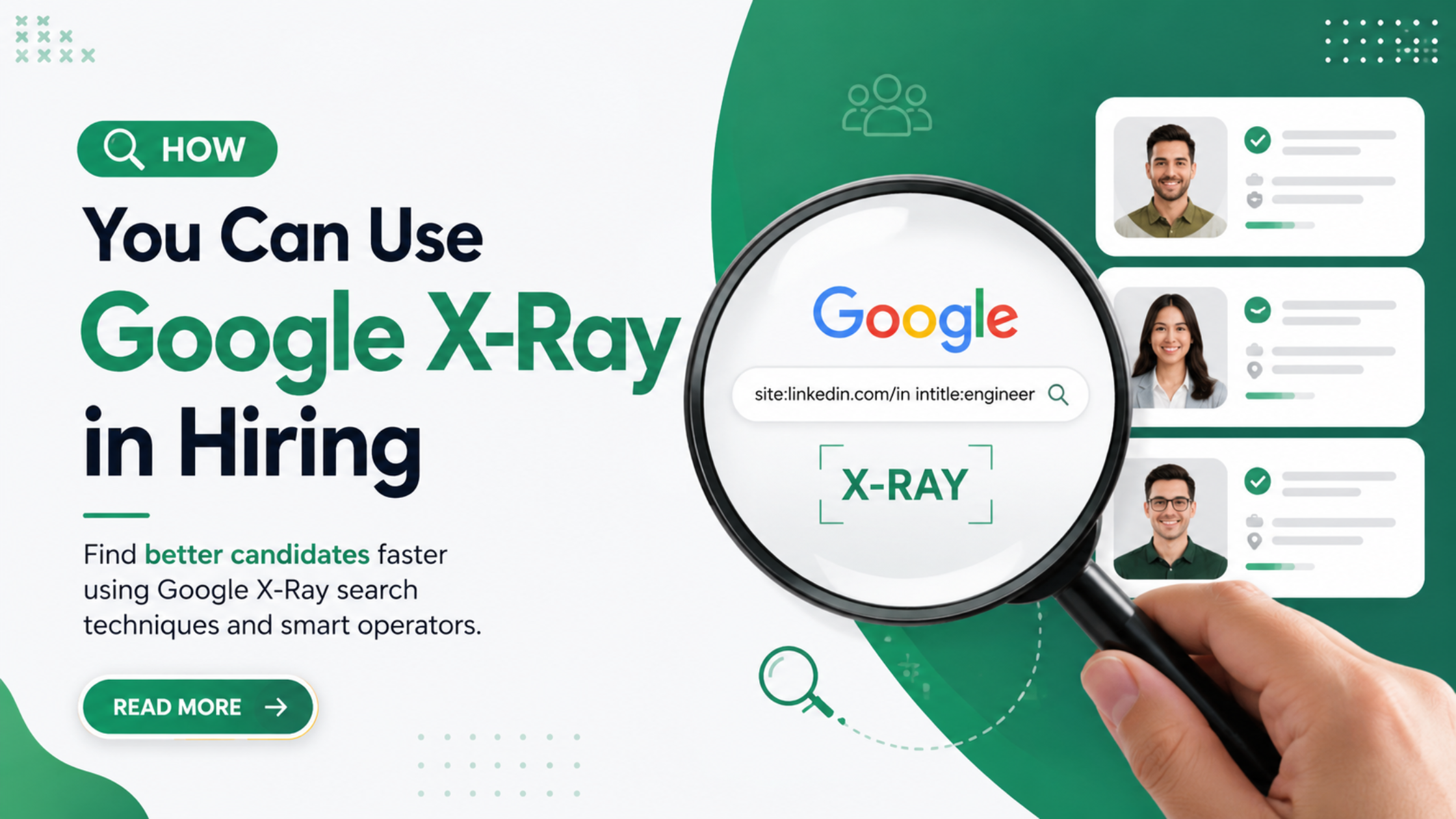
Hiring top talent has become more competitive than ever. While job boards and professional networks remain valuable, many qualified candidates are difficult to find through platform searches alone.
Google X-Ray Search is a recruitment technique that uses Google's search operators to find publicly available candidate profiles across websites like LinkedIn, GitHub, Stack Overflow, portfolio websites, and company directories.
Recruiters and staffing agencies use Google X-Ray to discover passive candidates, improve sourcing accuracy, and reach talent beyond traditional job boards. When combined with an Applicant Tracking System (ATS), recruiters can efficiently organize, track, and manage every candidate throughout the hiring process.
In this guide, you'll learn what Google X-Ray is, how it works, practical search examples, its benefits and limitations, and why modern recruiters combine it with ATS software for faster hiring.
What Is Google X-Ray?
Google X-Ray Search is an advanced sourcing method that helps recruiters search publicly available candidate profiles using Google instead of relying only on a website's internal search.
Rather than searching directly on LinkedIn or GitHub, recruiters use Google Search operators to narrow results by job title, skills, company, location, certifications, or experience.
For example:
site:linkedin.com/in "Software Engineer" "New York"
This search tells Google to display LinkedIn profiles that contain both "Software Engineer" and "New York."
Google indexes billions of webpages, making it one of the most effective tools for discovering qualified candidates across multiple online platforms.
Why Recruiters Use Google X-Ray Search
Google X-Ray Search helps recruiters access talent that may not appear through standard recruitment searches.
Some of the biggest advantages include:
- Find passive candidates
- Search beyond job portals
- Discover niche technical talent
- Source candidates using specific skills
- Build larger talent pipelines
- Reduce manual sourcing time
- Improve hiring efficiency
For recruitment agencies and enterprise hiring teams, Google X-Ray has become an essential sourcing strategy.
How Does Google X-Ray Search Work?
####Google Search supports advanced operators that help narrow search results.
Here are the most commonly used operators.
Operator
Purpose
Example
site:
Search a specific website
site.com/in
""
Exact phrase search
"Data Scientist"
OR
Search multiple keywords
Python OR Java
-
Exclude keywords
-intern
intitle:
Search page titles
intitle
inurl:
Search URLs
inurl
filetype:
Find documents
filetype
By combining multiple operators, recruiters can build highly targeted searches that return more relevant candidate profiles.###
Google X-Ray Search Examples
Find LinkedIn Profiles
site:linkedin.com/in "DevOps Engineer" "Texas"
Search Java Developers
site:linkedin.com/in "Java Developer" "Chicago"
Search AI Engineers
site:linkedin.com/in ("AI Engineer" OR "Machine Learning Engineer") Python
Search GitHub Developers
site:github.com "React Developer"
Search AWS Professionals
site:linkedin.com/in "AWS Solutions Architect"
Search by Company
site:linkedin.com/in "Microsoft" "Product Manager"
Search Candidates with Certifications
site:linkedin.com/in AWS Certified Solutions Architect
Where Can You Use Google X-Ray?
Google X-Ray isn't limited to LinkedIn.
Recruiters commonly search:
- GitHub
- Stack Overflow
- Behance
- Dribbble
- Kaggle
- Medium
- Personal Portfolio Websites
- Company Employee Pages
- Research Publications
This allows recruiters to evaluate candidates based on their work, technical contributions, and professional presence.
Benefits of Google X-Ray Search
Access Hidden Talent
Many experienced professionals don't actively apply for jobs but maintain public professional profiles. Google X-Ray helps recruiters discover these passive candidates.
Better Search Precision
Instead of browsing thousands of profiles, recruiters can search using specific skills, certifications, companies, or locations.
Faster Candidate Sourcing
Google's indexing often surfaces profiles that are difficult to locate through platform searches.
Cost-Effective Recruitment
Google X-Ray reduces dependence on premium sourcing tools and expensive recruiter licenses.
Better Candidate Quality
Targeted searches often produce more relevant and experienced candidates than broad keyword searches.
Limitations of Google X-Ray Search
Although Google X-Ray is an excellent sourcing technique, it doesn't replace a recruitment management system.
Some limitations include:
- Candidate information must be collected manually.
- No resume parsing.
- No interview scheduling.
- No hiring workflow.
- No team collaboration.
- No recruitment analytics.
- No automated follow-ups.
- Difficult to manage large talent pools.
As hiring grows, managing candidates manually becomes inefficient.
Google X-Ray vs LinkedIn Search
####
Feature
Google X-Ray
LinkedIn Search
Uses Google Search
Yes
No
Searches Public Profiles
Yes
Limited
Advanced Search Operators
Yes
Limited
Free to Use
Yes
Partially
Finds External Profiles
Yes
No
Recruitment Workflow
No
No
Google X-Ray helps recruiters discover candidates, but it doesn't manage the recruitment process.
###
Why Google X-Ray Alone Isn't Enough
Finding candidates is only the first step.
Recruiters also need to:
- Store candidate information
- Track hiring stages
- Schedule interviews
- Share hiring feedback
- Send emails
- Maintain talent pools
- Generate hiring reports
- Collaborate with hiring managers
Managing all these tasks manually usually leads to slower hiring and missed opportunities.
That's why recruiters combine Google X-Ray with an Applicant Tracking System (ATS).
How an Applicant Tracking System Improves Google X-Ray Hiring
An Applicant Tracking System (ATS) helps recruiters organize every candidate discovered through Google X-Ray.
Instead of maintaining spreadsheets, recruiters can store all candidate information in one centralized recruitment platform.
Modern ATS Software provides features like:
- Resume Parsing
- Candidate Database
- AI Candidate Matching
- Interview Scheduling
- Recruitment CRM
- Email Automation
- Hiring Pipeline Management
- Team Collaboration
- Recruitment Analytics
- Candidate Status Tracking
Google X-Ray helps you find candidates.
ATS Software helps you hire candidates faster.
Using both together creates a structured, scalable recruitment process.
Best Practices for Google X-Ray Search
To improve sourcing results:
- Use exact job titles.
- Combine skills with locations.
- Search multiple platforms.
- Include certifications when relevant.
- Test different Boolean combinations.
- Save successful search strings.
- Regularly update sourcing queries.
- Import qualified candidates into your Applicant Tracking System immediately.
Common Google X-Ray Search Mistakes
Many recruiters don't get the best results because they:
- Use very broad keywords.
- Ignore Boolean operators.
- Search only one platform.
- Don't include locations.
- Skip certifications.
- Fail to organize sourced candidates.
- Depend only on manual tracking.
Avoiding these mistakes improves both sourcing quality and hiring efficiency.
Google X-Ray Search Workflow
A simple hiring workflow looks like this:
- Define the job requirements.
- Build a Google X-Ray search string.
- Find candidate profiles.
- Review candidate experience.
- Import candidates into ATS Software.
- Parse resumes automatically.
- Schedule interviews.
- Track hiring progress.
- Collaborate with hiring managers.
- Make hiring decisions faster.
Why Recruitment Agencies Use ATS Software with Google X-Ray
Recruitment agencies often source hundreds of candidates every week.
Without an Applicant Tracking System, recruiters spend hours updating spreadsheets, following up manually, and searching previous candidates.
ATS Software helps agencies:
- Build searchable talent pools
- Track every candidate
- Reduce hiring time
- Improve recruiter productivity
- Eliminate duplicate profiles
- Maintain recruitment history
- Improve candidate experience
Combining Google X-Ray with ATS Software creates a complete recruitment workflow—from sourcing to onboarding.
Conclusion
Google X-Ray Search is one of the most effective candidate sourcing techniques available to recruiters. It helps hiring teams discover qualified professionals across LinkedIn, GitHub, portfolio websites, and other publicly indexed platforms.
However, sourcing candidates is only one part of recruitment. To organize applicants, automate hiring workflows, schedule interviews, and collaborate efficiently, recruiters need an Applicant Tracking System.
When Google X-Ray Search is combined with modern ATS Software, recruitment becomes faster, more organized, and more scalable. Whether you're a staffing agency, corporate recruiter, or talent acquisition team, using both tools together can significantly improve hiring outcomes.